
Beyond 800+ Developments: The Different Routes to Development
As Shawbrook Development Finance marks ten years supporting developers, Terry Woodley, Managing Director, Development Finance at Shawbrook, looks beyond the headline figure of 800+ developments to explore the different projects, opportunities and funding requirements behind a decade of development.

Since launching our Development Finance proposition in 2016, we've supported more than 800 development projects¹ across a wide range of property types.
Some have created new homes from the ground up. Others have involved the refurbishment or conversion of existing buildings, alongside mixed-use, commercial and specialist schemes.
Beyond the type of property being developed, the approach to delivering it can vary considerably. Behind each project are different opportunities, challenges and decisions about how best to bring a scheme forward.
Different developments. Different approaches.
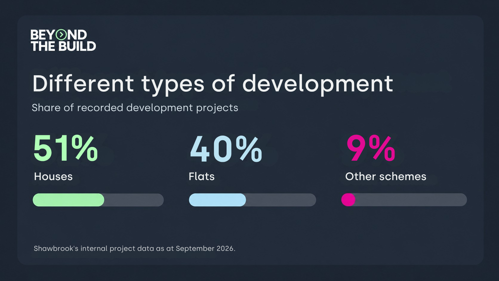
Houses account for just over half of the developments recorded across our portfolio, with flats representing around four in ten. The remainder spans commercial, mixed-use and specialist schemes.
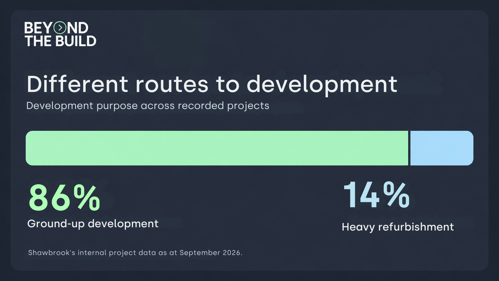
Across projects where development purpose is captured, around 86% were ground-up schemes and 14% involved heavy refurbishment.
It's a reminder that development isn't always about starting with a clear site and building from scratch. Existing buildings can present opportunities too, whether through substantial refurbishment, conversion or finding a new use for an underused property. Each brings different considerations, from planning and construction requirements to how a scheme is funded and ultimately delivered.
From restaurant to veterinary hospital
Heavy refurbishment, Stirling, Scotland
A £1.57m Development Finance facility supported the transformation of a former restaurant into a specialist veterinary hospital, with extensive refurbishment and adaptations to accommodate its new use.
Supporting more than construction
Funding requirements can also change throughout the development lifecycle.
Alongside core Development Finance, we've introduced Planning Assistance and Development Exit Finance to support different stages of a project. In 2025, these facilities together accounted for just over a quarter of our Development Finance activity.
That reflects the importance of looking beyond the construction phase. For some developers, the challenge is enhancing planning permission to maximise a site’s potential. For others, it's managing the period after practical completion, when sales or refinancing may take longer than originally anticipated.
Supporting these different requirements has become an important part of how our proposition has evolved over the past decade.
Backing the journey beyond completion
A £10.8m Development Exit facility helped an experienced family-run developer consolidate existing borrowing, demonstrating how funding requirements can extend beyond construction.
A diverse market today
The same variety is reflected in the wider development market today.
Our latest research among 500 professional property developers² found that 53% had worked on mixed-use retail and residential projects in the previous three months, while 46% had worked on houses, 41% on student accommodation and 39% on flats.
But the type of development is only part of the decision. How a developer intends to use or exit a scheme can be just as important.
In our Beyond the Build conversation with TU Real Estate, Umer explains how the business assesses each development individually rather than following a fixed build-to-sell or investment strategy. Generally, the business retains flats as investments, while strong demand for newly built houses in its region has made selling the preferred approach for those schemes.
It demonstrates why a fixed development strategy doesn't necessarily suit every opportunity. The decision to sell or retain a scheme can depend as much on local demand and the type of property as the developer's longer-term objectives.
Beyond the Build
After ten years and more than 800 developments, one lesson stands out. Successful development isn't defined by a single approach. It requires an understanding of the opportunity, the market and the decisions that shape a project from planning through to exit.
Over the coming weeks, Beyond the Build will continue to look beyond the numbers, sharing the customer stories, developments and insights that have shaped our first decade of Development Finance.
¹ Shawbrook internal Development Finance project records, as at September 2026. Figures reflect available records.
² Research conducted among 500 professional property developers aged 21+ between 14–25 August 2026. Respondents develop property as a business or occupation. Multiple responses were permitted.